
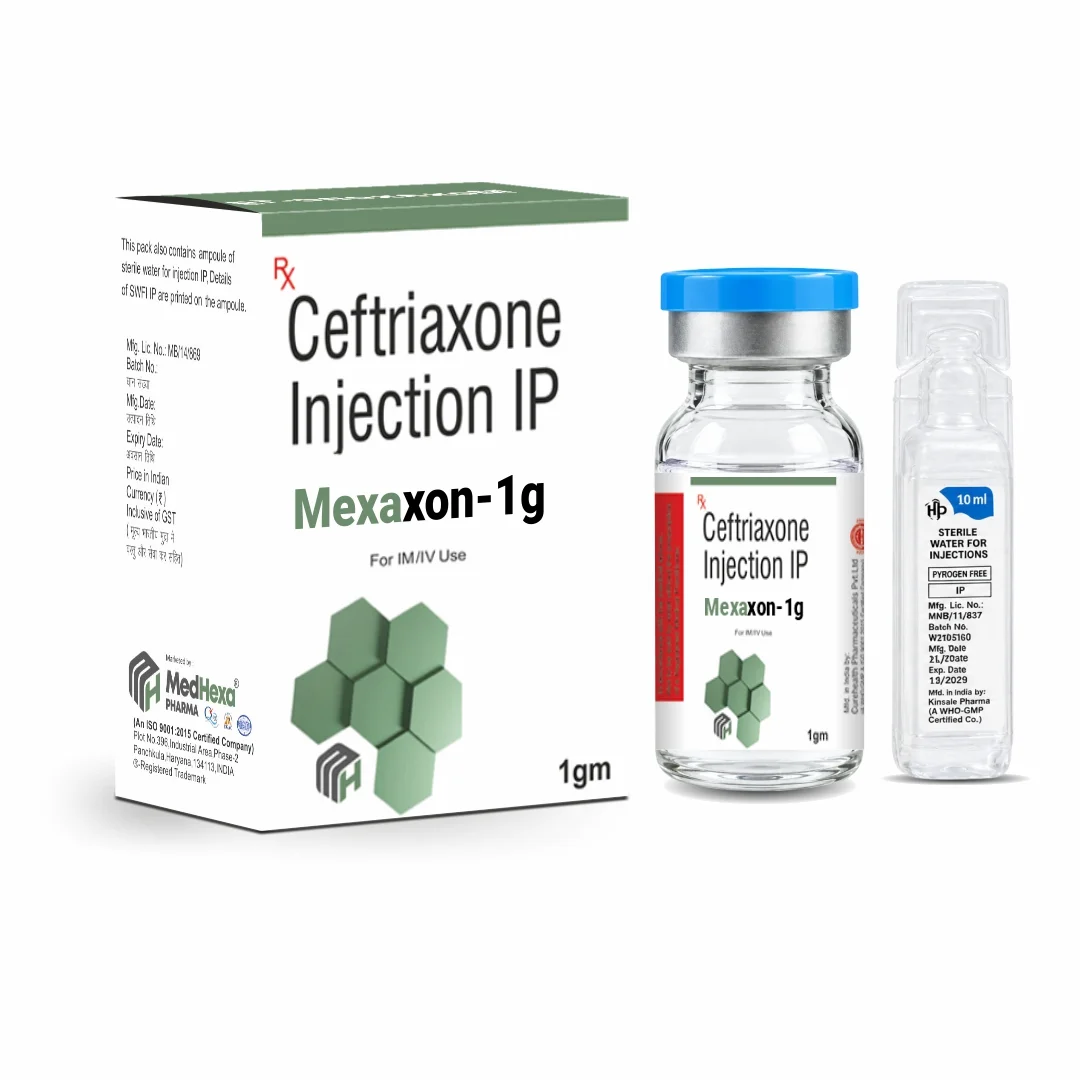
Description
MEXAXON-1G contains Ceftriaxone 1000 mg Injection, a third-generation cephalosporin antibiotic used under medical supervision for selected bacterial infections. Ceftriaxone works by interfering with bacterial cell-wall synthesis, which helps control susceptible bacterial infections. It can be administered by the intravenous or intramuscular route according to the prescribed formulation and clinical requirement.
MEXAXON-1G may be considered in hospital and clinical settings for susceptible bacterial infections involving the skin and soft tissues, bones and joints, urinary tract, respiratory tract and other sites. Ceftriaxone also has established activity against Neisseria gonorrhoeae, although the appropriate dose and route depend on the specific infection and current treatment guidelines.
For related antibiotic formulations and other pharmaceutical products, explore the Medhexa Pharma Products range.
Therapeutic Segment
Antibiotics | Cephalosporin Antibiotics | Injectable Antibiotics | Critical Care | Hospital Use
Uses of MEXAXON-1G
MEXAXON-1G may be prescribed for selected bacterial infections caused by susceptible organisms. Depending on the clinical situation, ceftriaxone is used for conditions such as:
- Skin and skin-structure infections
- Bone and joint infections, including selected cases of osteomyelitis
- Acute bacterial otitis media
- Urinary tract infections
- Lower respiratory tract infections
- Bacterial septicemia
- Selected intra-abdominal infections
- Gonococcal infections
- Other serious bacterial infections identified by the treating healthcare professional
The official ceftriaxone labeling lists skin and skin-structure infections, bone and joint infections, acute bacterial otitis media, urinary tract infections, septicemia, intra-abdominal infections and uncomplicated gonorrhea among its indications when caused by susceptible organisms.
Important: The product information supplied for MEXAXON-1G also mentions cholecystitis, chronic suppurative bacterial otitis media, chancroid and syphilis. These conditions should not automatically be presented as indications for every 1 g ceftriaxone product. For example, current CDC guidance recommends ceftriaxone 500 mg IM for uncomplicated gonorrhea in adults weighing under 150 kg, while ceftriaxone 1 g is used for certain complicated gonococcal infections. CDC guidance also continues to recommend penicillin-based therapy for syphilis; ceftriaxone has limited evidence as an alternative in some circumstances. For chancroid, CDC lists ceftriaxone 250 mg IM as one treatment option.
Key Benefits of MEXAXON-1G
- Contains Ceftriaxone 1000 mg in injectable form.
- Provides broad-spectrum antibacterial activity against susceptible organisms.
- Suitable for clinical situations where injectable antibiotic therapy is required.
- May be used for selected skin and soft-tissue bacterial infections.
- May support treatment of selected bone and joint infections.
- Can be used for selected respiratory, urinary and intra-abdominal bacterial infections.
- Has established activity against susceptible Neisseria gonorrhoeae infections.
- Can be administered by qualified healthcare professionals through the appropriate IM or IV route.
Ceftriaxone acts against susceptible bacteria by inhibiting bacterial cell-wall synthesis. However, antibiotic selection should consider culture results, susceptibility testing and local resistance patterns whenever available.
How MEXAXON-1G Works
Ceftriaxone belongs to the third-generation cephalosporin group of antibiotics. It acts as a bactericidal antibacterial agent by interfering with the formation of the bacterial cell wall. As a result, susceptible bacteria cannot maintain their cell-wall structure and may die.
Because bacterial resistance can reduce antibiotic effectiveness, healthcare professionals should use ceftriaxone only when a susceptible bacterial infection is proven or strongly suspected. Culture and antimicrobial susceptibility information can help guide treatment whenever available.
Common Side Effects of MEXAXON-1G
Ceftriaxone can cause side effects, although not everyone experiences them. Common or clinically reported reactions may include:
- Injection-site pain or discomfort
- Diarrhea
- Nausea or vomiting
- Skin rash
- Headache
- Changes in liver-related laboratory values
- Eosinophilia or other blood-count changes
More serious reactions can occur rarely, including severe allergic reactions, serious skin reactions, Clostridioides difficile-associated diarrhea and hemolytic anemia. Patients should receive prompt medical attention if severe or unusual symptoms develop.
Important Safety Information
MEXAXON-1G should be administered only under the direction of a qualified healthcare professional.
- Do not use ceftriaxone in patients with a known serious hypersensitivity to ceftriaxone or other cephalosporins.
- Patients with previous serious reactions to penicillins or other beta-lactam antibiotics may require additional caution.
- Serious allergic reactions, including anaphylaxis, can occur.
- Ceftriaxone should not be mixed or administered simultaneously with calcium-containing IV solutions because precipitation can occur.
- Special restrictions apply to neonates, particularly premature or hyperbilirubinemic neonates and neonates requiring calcium-containing IV solutions.
- Prolonged or inappropriate antibiotic use can contribute to antimicrobial resistance.
- Persistent or severe diarrhea during or after antibiotic treatment requires medical assessment because C. difficile-associated diarrhea can occur.
- Tell the healthcare professional about previous antibiotic allergies and all medicines currently being used.
DailyMed provides the prescribing information and safety details for ceftriaxone injection.
Dosage & Administration
The dosage of ceftriaxone depends on the patient’s age, weight, infection, severity, causative organism, route of administration and clinical response.
For adults, official ceftriaxone labeling commonly describes 1–2 g once daily or in equally divided doses, depending on the infection, with a maximum total daily dose of 4 g in that labeling. However, the correct regimen for MEXAXON-1G must be determined by the treating healthcare professional rather than inferred from the vial strength.
For gonorrhea specifically, current CDC guidance recommends ceftriaxone 500 mg IM as a single dose for uncomplicated urogenital, anorectal or pharyngeal gonorrhea in adults weighing under 150 kg, while 1 g is recommended for persons weighing 150 kg or more. Other gonococcal complications require different regimens.
The injection should be prepared and administered according to the manufacturer’s instructions and the healthcare professional’s prescription. The appropriate diluent and route should be confirmed before administration.
Storage
Store MEXAXON-1G according to the manufacturer’s labelled storage instructions. Keep the vial protected from unsuitable environmental conditions and out of reach of children.
After reconstitution, the solution should be handled according to the product’s approved instructions regarding stability, storage and administration.