How Artificial Intelligence Is Revolutionizing the Pharmaceutical Industry: Trends, Benefits & What's Next
The pharmaceutical industry has always run on patience years of research, testing, and regulatory review standing between a promising molecule and a life-saving medicine. AI in pharma industry applications are changing that timeline fast, weaving into nearly every stage of drug development, from faster drug discovery to smarter clinical trials and treatments tailored to individual patients. Learn more about MedHexa Pharma’s approach to innovation and how we’re staying ahead of these shifts.
In this article, we’ll break down exactly how AI is reshaping pharma, the technology behind it, real-world examples, the benefits companies are seeing, and what’s coming next.
What Is AI's Role in the Pharmaceutical Industry?
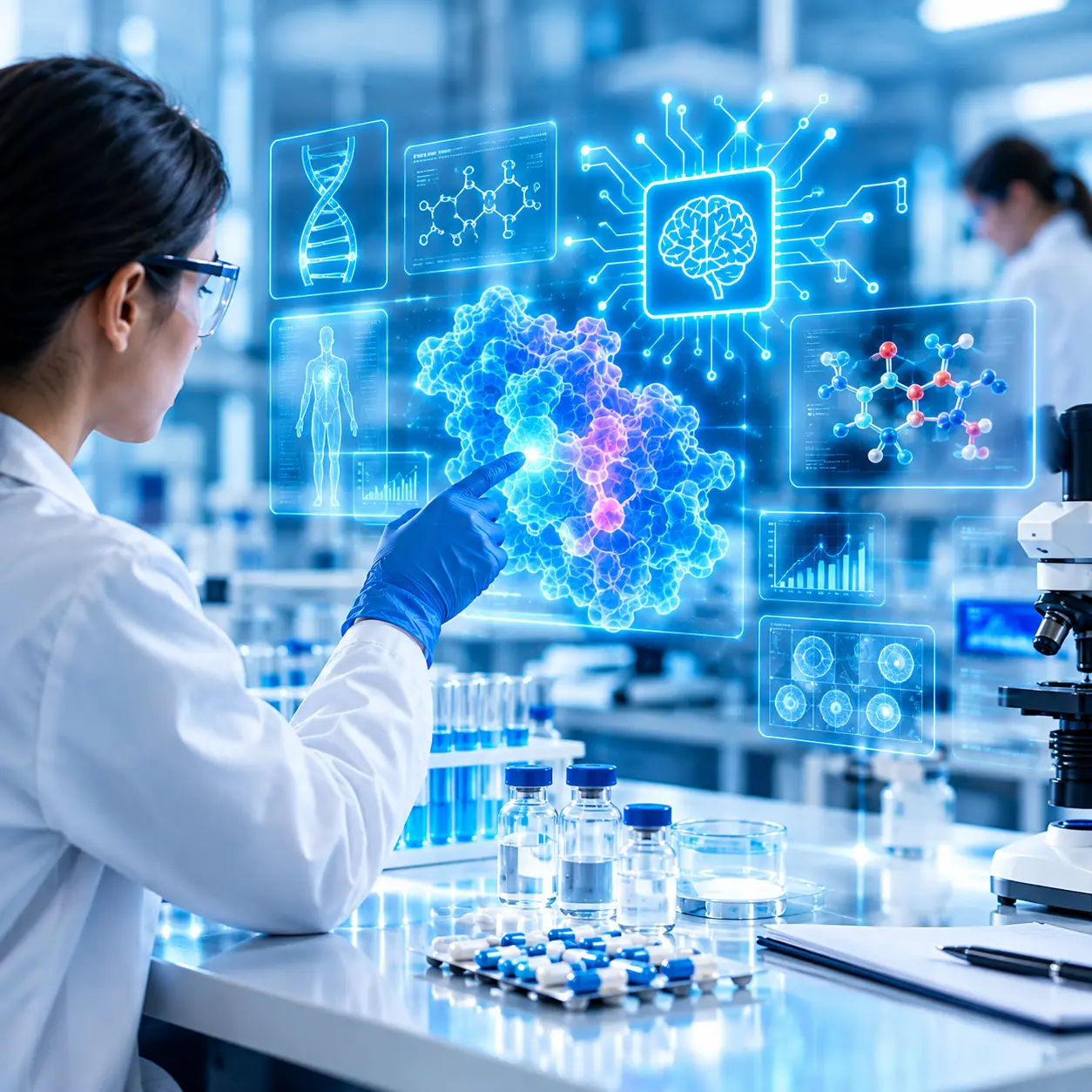
AI in pharma uses machine learning, deep learning, natural language processing, and predictive analytics to speed up drug development – from identifying new compounds to predicting how a drug behaves in the body, long before it reaches a lab bench.
Instead of slow, expensive trial-and-error, researchers now use AI models trained on massive datasets to predict which molecules are most likely to succeed. This is changing the basic economics of how medicines get made.
Types of AI driving this shift:
- Machine learning (ML): Spots patterns to predict drug behavior.
- Deep learning: Powers protein structure prediction and image-based diagnostics.
- NLP: Scans research papers and clinical notes for insights.
- Generative AI: Designs new molecular structures from scratch.
Key Ways AI Is Transforming Pharmaceuticals
1. Faster Drug Discovery
Traditional drug discovery takes 10 to 15 years and costs over a billion dollars per drug, with most candidates failing along the way. AI platforms analyze genomic data, protein structures, and chemical libraries to find promising candidates much faster.
DeepMind’s AlphaFold, which predicts protein structures accurately, has given researchers a head start on understanding disease targets. Companies like Insilico Medicine and Exscientia have moved AI designed drugs into clinical trials faster than industry norms.
2. Smarter Clinical Trials
Clinical trials are often the most expensive and slowest phase of drug development. A major reason trials fail is poor patient selection or slow recruitment. AI helps by:
- Identifying ideal patient candidates based on genetic and health data
- Predicting which patients are likely to respond well to treatment
- Monitoring real time data during the trial to catch issues early
- Reducing dropout rates through better trial design and remote monitoring
This saves money, speeds up approvals, and reduces the number of patients exposed to trials unlikely to help them.
3. Personalized Medicine
One-size-fits-all treatment is slowly becoming a thing of the past. By analyzing a patient’s genetic profile, lifestyle data, and medical history, AI enables treatments tailored specifically to them.
This is especially powerful in:
- Oncology: Matching cancer patients to therapies most likely to target their specific tumor genetics
- Rare diseases: Identifying small, scattered patient populations that would be nearly impossible to find manually
- Chronic disease management: Predicting how a patient will respond to a treatment before it’s prescribed
4. Predictive Drug Safety
Adverse drug reactions are a leading cause of clinical trial failure and post-market drug withdrawals. Machine learning models can now flag potential toxicity, side effects, and drug interactions earlier in development by analyzing molecular structure and historical safety data. This reduces costly failures in late-stage trials or after a drug reaches the market.
5. Smarter Manufacturing
AI is transforming the pharma factory floor as much as the research lab. Predictive maintenance models flag equipment issues before they cause downtime. Computer vision systems catch defects during production that human inspectors might miss. Real-time quality monitoring ensures batch consistency at scale, reducing waste and recalls.
6. Drug Repurposing
AI can quickly scan existing approved drugs, already proven safe in humans, to identify new potential uses for different conditions. Because these drugs have already cleared safety testing, repurposing brings treatments to patients far faster than developing something entirely new. This approach proved especially valuable during recent global health emergencies, when speed was critical
7. AI-Powered Drug Design (Generative Chemistry)
Perhaps the most futuristic application is generative AI, which can design entirely novel molecules optimized for specific properties like binding affinity, stability, and low toxicity, rather than just screening existing compound libraries. This flips the traditional discovery process on its head, moving from “search and test” to “design and verify.
Benefits of AI in Pharma Industry Adoption
- Speed: Reduces years off the drug development timeline
- Cost savings: Lowers R&D expenses by minimizing trial-and-error and failed candidates
- Accuracy: Improves prediction of drug efficacy and safety before human trials begin
- Personalization: Enables precision medicine at scale, matching treatments to patients
- Innovation: Opens doors to treatments for complex diseases once considered too costly or difficult to pursue
- Accessibility: Lower development costs can eventually translate to more affordable treatments
Challenges Still Facing AI in Pharma
It’s not all smooth sailing. The industry still faces real obstacles:
- Regulatory uncertainty: Agencies like the FDA are still developing clear frameworks for evaluating AI-driven drug discovery and AI-based diagnostic tools
- Data privacy and security: Patient data used to train AI models must be handled with strict compliance to regulations like HIPAA and GDPR
Data quality and bias: AI models are only as good as the data they’re trained on biased or incomplete datasets can lead to flawed predictions
- Integration challenges: Many pharma companies still run on legacy systems that aren’t built to work seamlessly with modern AI tools
- Trust and interpretability: Researchers and regulators need to understand why an AI model made a prediction, not just accept the output blindly
What's Next for AI in Pharmaceuticals?
Looking ahead, expect to see:
- Deeper generative AI integration for designing novel molecules from scratch
- Wider adoption of AI-powered diagnostics that catch diseases earlier and more accurately
- Increased collaboration between traditional pharma giants and AI-first biotech startups
- Maturing regulatory frameworks as agencies build clearer guidelines for AI-assisted drug approval
- AI-driven clinical trial design becoming standard practice rather than the exception
As these pieces come together, AI is expected to move from a “nice-to-have” innovation to a core pillar of pharmaceutical R&D not replacing the scientific process, but fundamentally accelerating it.
Final Thoughts
AI isn’t replacing scientists it’s giving them superpowers. By handling the heavy lifting of data analysis, pattern recognition, and prediction, AI allows pharmaceutical researchers to focus their expertise on innovation and judgment calls that still require a human touch. The result: safer, more effective treatments reaching patients faster than ever before.
The pharmaceutical companies that embrace this shift today are the ones most likely to lead the industry tomorrow.
Looking for the Best Pharmaceutical Company in Panchkula?
Partner with Medhexa Pharma Pvt. Ltd. for premium-quality pharmaceutical products, dependable supply, and professional business support.
Frequently Asked Questions (FAQs)
How is AI used in the pharmaceutical industry?
AI is used across drug discovery, clinical trial design, patient recruitment, drug safety monitoring, manufacturing quality control, and personalized treatment planning. It helps pharmaceutical companies analyze massive datasets faster and more accurately than traditional methods allow.
Can AI actually discover new drugs?
Yes. AI models can analyze chemical and biological data to identify promising drug candidates, and generative AI can even design entirely new molecular structures. Several AI-discovered drug candidates have already entered human clinical trials.
How much time does AI save in drug development?
While traditional drug discovery can take 10–15 years, AI-assisted approaches have helped move some candidates from initial discovery to clinical trials in under two years — though full development and approval still typically takes several years due to regulatory testing requirements.
Is AI replacing pharmaceutical researchers and scientists?
No. AI is a tool that handles data-heavy, repetitive tasks like pattern recognition and prediction, freeing up scientists to focus on experimental design, interpretation, and decision-making that require human expertise and judgment.
What are the biggest risks of using AI in pharma?
Key risks include data privacy concerns, potential bias in AI training data, regulatory uncertainty around AI-driven decisions, and the “black box” problem — where it’s difficult to understand exactly why an AI model made a specific prediction.